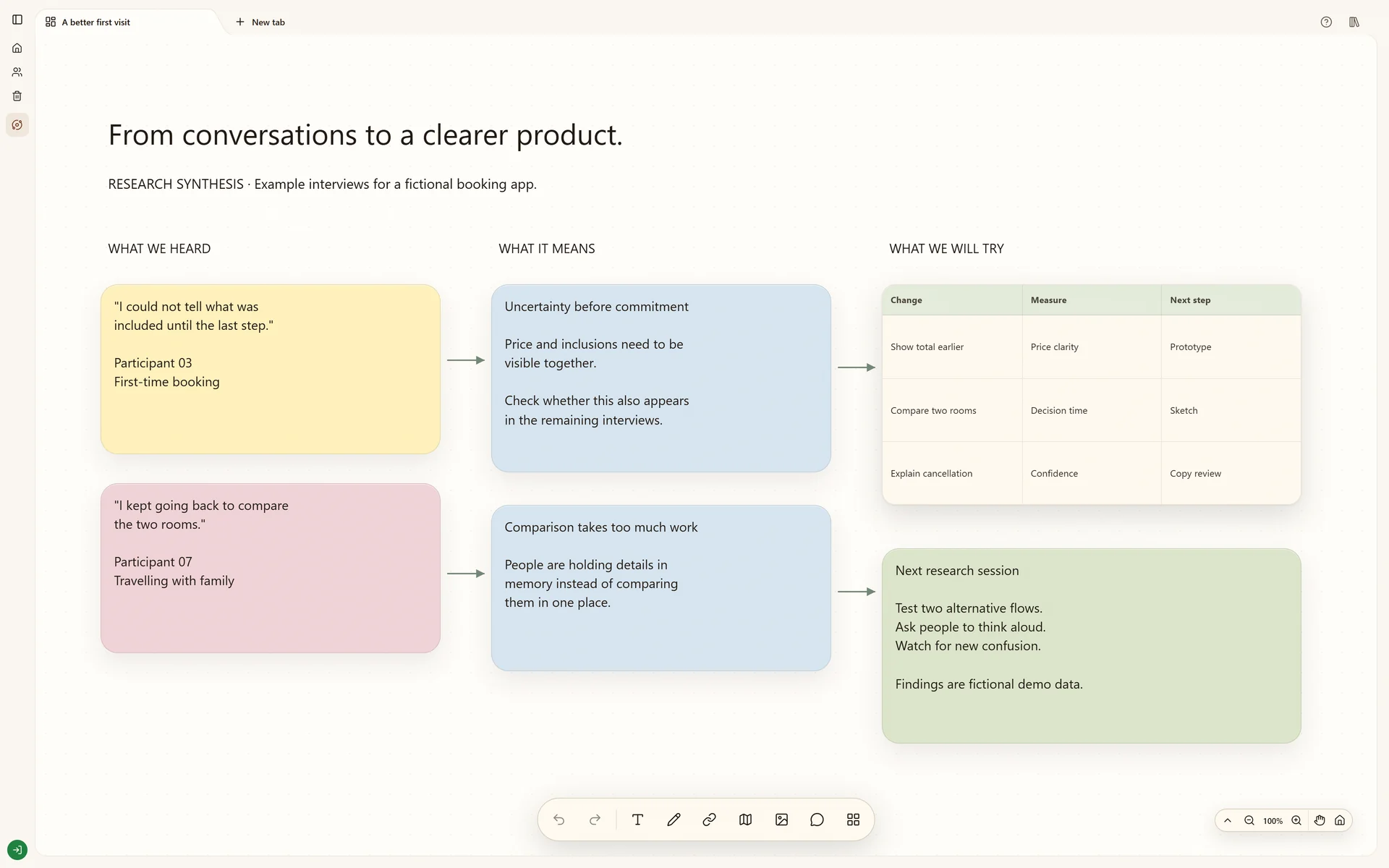
How do I organize research without losing the source?
Keep the original URL next to your observation, record when you checked it, and separate evidence from interpretation. Group sources around the question they help answer, then connect the strongest evidence to your decision or outline.
Instead of naming a board Research, use a concrete question such as: which booking flow should we prototype? Write the audience, scope and deadline in a note. A clear question limits the number of sources you need and makes missing evidence visible.
Give each source a job
Paste a source link and add a short observation beside it. Record the date and distinguish what the source actually says from your interpretation. For example, a product page can support a feature comparison, but it cannot establish that customers prefer that feature. Use anonymized notes for interviews and avoid putting private participant details on a shared board.
Group evidence, questions and hypotheses
Arrange sources around themes such as onboarding, pricing and accessibility. Keep unresolved questions in their own area so they do not become conclusions by repetition. Draw connectors only where a relationship is meaningful. A crowded cluster of links is not evidence by itself.
Turn the collection into a decision
Write a short conclusion with the sources that support it and any counterexamples. Keep your shortlist separate from the wider collection. If you connect an AI assistant, ask it to find saved references or draft a summary, then check each claim against the original source. Only share material you are allowed to send to the connected AI service.
Before you call it finished
The research question is specific.
Sources have URLs and dates.
Observations and interpretations are separate.
Counterexamples and open questions remain visible.
The final decision points back to evidence.
Start with the tools you need
Try local boards without an account. They stay in this browser until you explicitly transfer them to your cloud account. Cloud storage, collaboration, desktop access, the Chrome extension, Telegram and connected AI tools require a paid Stashiro account.